Sunday, 19 August 2012

Blue winged teal

Just back off holiday (pictures currently being processed), and Sarah Lurcock left a message to say she’d seen my duck flying towards Grytviken. So I headed out with my big lens, and went for a look. Sure enough, within about 250m of leaving base there it was, feeding with a group of South Georgia Pintails in the edge of the water.

20120819-DSC_8034

Most of the wildlife around here takes little notice of people, the ducks tend to be a little twitchy, although if you stand still and quiet they will still come to within 10m.

20120819-DSC_8176

Every now and again it would fly 20 or so metres along the shore to catch up with the moving group of pintails, I managed to get a photo, which although not perfectly sharp, does show the blue wing patch very well.

20120819-DSC_8218

Sunday, 12 August 2012

Odd duck

While we were out filming for the Antarctic 48hr Film festival I spotted a different duck. I managed to get this photo, not great as it was distant and on my compact. But good enough for i.d. My thought of Blue winged teal, was confirmed by a couple of birders in the Falklands, so rather pleased. This could be the second sighting on the island so a good spot. Unfortunately I’ve not seen it again, and I’ve been dragging my 500mm lens and tripod around with me in the hope of a better photo ever since!

Blue winged teal and South Georgia Pintail

While I had my beast of a lens out I took a few other photos. The South Georgia pintail can look a bit ‘boring brown duck’ from a distance, but up close they are quite pretty. They have a lovely little call too, a gently whistle, with an even quieter ‘ziiip’ in it too.

South Georgia Pintail

South Georgia Pintail

Spring must be on it’s way. The Pintail seem to be getting a bit frisky, and the Terns are too. I caught this pair courting with a nice little fish one had caught. I was quite pleased with the snowy background isolating them, and letting the contrast in their plumage show up better.

Antarctic Terns courtship feeding in the snow

Fingers crossed the Blue winged teal will appear again, and until then I’ll carry on hulking my big lens around, even if it doesn’t appear it’s a worthwhile effort.

Tuesday, 31 July 2012

Transport in deep snow

We’ve had a lot of snow over the last few days, and some spells of strong wind too creating some big, soft, drifts around base. Other than skis the best way to get around is with snow shoes. And to make them easy to put on and take off what better than a pair of wellies! We’ve got quite a lot of these Dunlop thermopro wellies on base, they are incredibly warm, have thick grippy soles, and come in a fetching orange. Most BAS kit comes in orange.

20120729-P1020512

These boots were great on the Fisheries Patrol Vessel last year when I had to stand outside on the bridge wing for around 3 hrs counting seabirds, penguins, seals and whales. It was flippin’ freezing, but my feet survived.

As for the snow shoes, these MSR Lightning Ascent snow shoes are great. These are a big pair, ideal for soft snow or carrying a rucksack. You still sink in quite a way, but I made the mistake of not using them once, and stepping into a snowshoe footprint I still sank another 50cm into the snow. They’re not to heavy, are easy to walk in (forwards), and go up hills with the heel raiser. The one issue is walking backwards or turning round, because they hinge off the ball of your foot the tail drops, if you don’t lift your foot high you end up tripping up, stumbling, and generally finish in a heap in the snow. All good fun!

Wednesday, 18 July 2012

Krill trawlers

20120706-DSC_5158There have been some Krill trawlers around for a few weeks. Saga Sea, a Norwegian vessel came in to tranship the other day, and I volunteered to be crew for Matt boat. Whenever there is a transhipment the Government officer has to go out to take a fuel sample, and get various bits of paperwork sorted. As well as getting daily reports of catches, the quantities of product are also recorded. If there are any scientific samples these are also dropped off to us at the base.

20120706-DSC_5161

While the transhipment was taking place some of the crew visited the museum in Grytviken. They used their own ‘fast response boat’, which was anything other than fast. Their engine had given up, so they were using their 25hp outboard and could only go at 4kts. At one point they also started to sink, but worked out that it was a leaky elephant trunk, which when raised stopped the ingress of water.


20120708-P1020347

Another Krill trawler has also arrived recently. The Fukuei Maru is an old traditional krill trawler (the Saga Sea uses a continuous pumping method). I went on board with the Government officer to give her a hand with the inspection. Having spent a week last year aboard an almost identical ship (Gong San), and helped the previous government officer do last years inspection on this same vessel I had a good idea what to expect, and was able to point out the important features of the net that needed checking. The main feature was the Sea20120708-P1020348 Lion Exclusion Device (SLED), which essentially is just a wide mesh preventing seals from swimming too deep into the net, instead they are funnelled towards an escape panel (pictured right). This is good news for the seals, as they don’t drown in the net, and good news for the fisherman as they don’t have a very angry or dead seal in the catch, it’s also a cheap and easy solution to implement to protect wildlife.
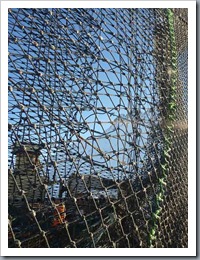
Traditional trawling

The Krill trawling nets are big, and usually you would get around 20 tonnes of Krill after trawling for around an hour. Shooting, hauling and reshooting also takes around an hour, giving around 12hrs fishing per day. The net is hauled on to the rear deck, and then emptied through a hatch into the factory below. In this way it is usual here to have a daily catch of up to 300 tonnes per day. These vessels have fairly standard nets and fishing gear, and lots of acoustic tech and a very skilled captain/mate on the bridge to trawl through the krill swarms, they can also carry on fishing when the weather starts to deteriorate.

Continuous pumping

With a continuous pump method the trawl net is deployed, and a long pipe goes into the cod end (the bit at the tail end of the net where catch collects) sucking out the Krill as it’s caught. The Krill then has to be sieved out of the water before being processed. This method allows almost 24hrs of fishing every day, and catch rates can be in the region of 600 tonnes or more a day. There are a number of technical difficulties with this method that need to be overcome. Turbulence in the net, pumping vast quantities of water/krill, slow trawl speeds, susceptibility to bad weather. The Norwegians however seem to have worked out most of this stuff, apart from controlling the weather!

20120708-P1020349

Sunday, 1 July 2012

Night wandering in Grytviken

The other evening was calm and clear, Erny suggested a wander around Grytviken to look at the stars and experience the ‘mood’ of the whaling station at night. I was only too keen to go too, and take a few photos while I was there. I wanted to have a play with something different to star trails and the milky way, and try to get some recognisable constellations and associate them with local features. I also discovered that the sometimes frustrating leading lights shed a new light on the machinery.

20120625-DSC_4075-Edit Grytviken Church and the Southern Cross

20120625-DSC_4089 Whalers accommodation block

20120625-DSC_4101 Long Shadows

20120625-DSC_4104 Machinery

20120625-DSC_4106 Boilers and tanks