Friday, 25 November 2011

A year gone by

Well, over a year has now gone by since I left the UK bound for South Georgia, and time seems to have just flown by! We made sure we celebrated the occasion, both 365 days since leaving the UK, and 365 days of being in South Georgia were remembered, with the latter being celebrated in a locally traditional manner by drinking Gin and Tonics. I bought the last bottle of Plymouth Navy strength  for the occasion, and it was headaches all round the next morning! It is truly potent stuff.

Rather than put some photos from down here up I thought I’d go back to the days before I left home, and remember the lovely time I had with family.

20101016-DSC_3458

20101016-DSC_3462

20101017-DSC_3467

20101017-DSC_3480

20101017-DSC_3489

Revisiting some old photos felt good and I was able to do more with them as a result, ending up with some pictures that I’m quite pleased with.

20101017-DSC_3506

Sunday, 2 October 2011

Gone Fishing

Having written the last blog shortly after my Krill Trawling experience I though I better do an update about my time on the trawler itself!

It was a busy weekend creating our entry to the Antarctic 48hr Film Festival, followed by getting up every couple of hours through the night to check on the status of it’s upload, then I was on earlies too. I went back to bed to get some sleep when the Fisheries Patrol Ship turned up and announced that it was taking me out right away to board a krill trawler! Unsurprisingly I was quite flustered and not best pleased.

I had been asked by the GSGSSI to board the trawler for a week as a scientific observer. They already had a Korean observer but wanted to carry out some extra monitoring for bycatch, seabird interaction, and Krill genetics.

20110802-P1010113 We headed out of Cumberland Bay, and whilst the ship was hauling it’s net and preparing for the next trawl I boarded. Being lowered off the FPV in the RIB was quite exciting, and we bounced over the waves to meet up with the Dong San. I had been briefed as to how to exit the rib, move to the bow when instructed, then wait until you get to the top of a wave, then climb the pilot ladder. I went up that ladder like a rat up a drainpipe, and landed on deck amongst a medley of Korean, Chilean, Philippino, and Vietnamese fishermen.

20110803-P1010179I was introduced to the Captain and some other officers on the bridge, and then shown to my cabin. The cabin was very basic, but comfortable enough, and came with it’s very own giant can of Raid cockroach killing spray. Unfortunately the head (toilet) and washing facility in my cabin had been demolished, but there were crew facilities just around the corner, they were um, very basic. Meals were served in the officers mess at 5am, 11am, 5pm and 11pm. The captain had kindly asked the cook to prepare more western, less spicy food for me which I was grateful for, but I also got to try a wide range of Korean food too. In the photo you can see my plate of food, ginseng tea, and a variety of small dishes which you share with the person opposite, and contains all sorts of extras. There was lots of fish, and freshies too which was a treat. I used the chopsticks almost all the time which was met with “you chopsticks very good”.

20110803-P1010157

Having been built in 1975 this ship has certainly seen better days. The bridge was particularly interesting, old instruments and control gear sat next to modern state of the art acoustic fish finding equipment. The instruments pictured here look aft onto the trawl deck so that the captain can see everything that is going on, he controls the engines monitors instruments, issues commands for shooting, trawling depth and hauling the net which is operated from a winch house. He also issues commands for steering which is performed by a crew member looking out of the front of the bridge.

20110802-P1010125What this ship is all about, catching Krill

Despite being an old vessel the captain uses her to catch an incredible amount of Krill. Every haul brings up 15-20 tonnes of Krill, and the net is hauled about once every 45mins to an hour. Fishing carries on day and night as long as there is a Krill swarm to be fished. After trawling through a swarm several times it reaches a point where fishing it again becomes unpractical. Then the search starts for another swarm. Steaming back and forth searching can take some time, and it’s quite common for different ships to fish in the same area, even the same swarm.

There were two main parts to my observing tasks, watching the warp lines and net for seabird interaction and sampling the catch looking for bycatch. Watching the net and warps required standing at the stern of the ship watching whilst it was shot or hauled, this was a pretty chilly task, although I tried to avoid times when it was actually snowing. Checking the catch was a slightly more comfortable task based inside the ship. Situated just below two hatches at the stern of the trawl deck are the bulk storage tanks. Krill is emptied through the hatches into the tanks where it then goes onto conveyor belts to be processed. It was my job to grab a tray full of catch (10-12kg) and sift through it looking for anything that wasn’t Krill. In the time it took to process the 15 or so tonnes of krill I could go through about 4 trays of Krill, and usually found very little else. I then had a few minutes where I could watch the conveyor and pick out any other bycatch.

Because Krill farms dense swarms there is generally very little else present in the catch. Only at night did the occasional fish get caught too, often with a mouthful of Krill having been feeding on the Krill itself.
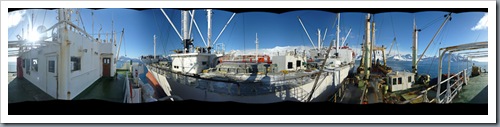
20110806-P1010217 Panorama

After 5 days aboard the hold was full and we headed into Cumberland Bay to meet up with a Reefer (refrigerated ship) to tranship the processed catch. Above is a 360 panorama of coming alongside. The reefer was alongside a tanker at the time refuelling, making the task slightly trickier. I was then picked up by the Harbour launch, and headed back to base for a nice hot shower.

Saturday, 13 August 2011

PTGui

Finally I bit the bullet and purchased a copy of PTGui, it’s rather an odd name, but actually stands for Panorama Tools Graphical User Interface. I’ve been putting it off for a while, but my backlog of panoramas isn’t getting any smaller, so thought I better get on with it.


When I first got into digital photography I’d spend several hours distorting and blending the separate images to create the finished product. Although time consuming the results were good. As photoshop developed they started to include an automatic stitching program. Most of the time photoshop will work fine, especially the latest versions, but often with night shots it gets all confused and just won’t play ball. This is where the manual controls in PTGui come in, if it can’t find control points to join the photos you can select them yourself. There are also endless projections and formats to export your panoramas, one of which is interactively on a web page.


Here is my first attempt at an interactive panorama that I took over in Maiviken the other night. Apparently it even works with the gyro in smartphones so you can wave them around to look in different directions! Click on the image below to go to my website to see it.


20110809-DSC_2926 Panorama

Wednesday, 10 August 2011

Winter holiday (part 2)

Having had my holiday to the Greene cut short I was lucky to be able to go away with Matt mech and Katie the next week. They planned a trip which I can only describe as “Antarctic Glamping” to Sorling on the Barff peninsula, which is in easy walking distance of the Nordeskjold glacier.

20110613-DSC_9670

We were dropped off by Jet boat and RIB, and had between us 5 large drybags, 3 sets of skiis and 3 sledges! Fortunately it was a calm day, so offloading onto the beach was fairly simple. Cosy camping was assured with sheepskin rugs for the floor, plenty of gin and tonic, and a few bottles of red wine.

On the first afternoon we headed out for a walk to Sorling beach. By now the snow was quite patchy and had a crusty surface. Rat footprints however were evident everywhere. Since the rat eradication on the Thatcher peninsula there have been no sightings of rat tracks, so it was interesting to see how obvious they were here where the eradication is yet to happen.

The afternoon and evening light was beautiful, and the ice floating in the bay, and passing whisps of cloud provided some nice opportunities for photographs.

20110613-DSC_9705

20110613-DSC_9731

20110613-DSC_9734
20110613-DSC_9743

The Barff peninsula is grazed by Reindeer (I posted some photos in my holiday trip to the Macaroni penguin Rookery a few months ago). In order to investigate their impact on the vegetation an exclosure was set up a few years ago. It’s still there, and the difference is quite obvious; there is so much more tussac growing inside than out. When the rats and reindeer are gone this island is going to transform into a very different place.

20110613-DSC_9735Reindeer grazing exclosure

At Sorling beach there were lots of old whale bones strewn about the place. These made for interesting subjects to photograph in the frost, ice, and setting winter sun. I was quite pleased with the cold feeling and high contrast shot below. The mist obscured low sun also provided some nice backlighting, and eventually turning into a lovely twilight sky.

20110613-DSC_9756

20110613-DSC_9758

20110613-DSC_9775The old hut at Sorling, we used it to store our ski gear and boatsuits.

20110613-DSC_9788

20110614-DSC_9843-Edit On the second day of the holiday we walked up to the Nordenskjold Glacier for the day. The sun was shining and it was a calm day. We sat for an hour or so watching the glacier waiting for it to calve. We weren’t disappointed, although it wasn’t a particularly big chunk that fell off. I had set my camera going for a time lapse, which I converted into a short piece of video (available to view at the end of this blog entry), and caught the calving in the left side of the view near the beginning. The various chunks of ice floating and bobbing around were also interesting to watch, and interesting to wander amongst when stranded on the beach like giant ice cubes.

20110614-DSC_9854Half way back from the glacier we stopped to admire the view, and have a G&T, using the stranded ice on the shore of course! It had been a glorious day, and we were also able to watch the sun as it disappeared behind the Thatcher peninsula, silhouetting the mountains and ice in the water.

20110614-DSC_0329

20110614-DSC_0301

With such a clear evening I had to do some star trail photography. It would have been perfect if not for the camera misting over and then frosting up in the cold! That’ll teach me for bringing it into the warm and not protecting it from the humidity with a bag! It wasn’t a complete write off however, and the resulting movie is available below.

Incidentally I’m writing this blog entry from the Dongsan Krill trawler. So no doubt my next blog will be about this trip.

Saturday, 23 July 2011

Winter Holiday (part 1)

Well it’s been a few weeks now, and I’ve only just got round to writing about my holiday! Even though winter is supposed to be my quiet time of year, with no breeding seals or penguins, I always seem to be as busy as ever, boating, counting birds, collecting seal poo, looking at plankton… Finding time to blog about my activities seems to be some way down my list, but I am trying!
Our campsite hidden in the tussacFortunately though I’ve had a chance to go on holiday for a few days to recharge the batteries. Sam (the doctor) was keen on getting away too, so we decided to head over to the Greene peninsula for a few days exploring. We were dropped off near the Harker and Hamburg glaciers by boat, and then made our campsite. A flat area sheltered between tussac lumps just above the beach was chosen, so we shovelled it clear in the knee deep snow. Stamping it down with snow shoes and then digging out chunks seemed to work well and I’m guessing had it not been for the calm weather and sunshine this part of the trip may have been slightly more arduous than it was! The ground was frozen, and stony, so getting the pegs in was a bit of a nightmare. With a bit of ingenious use of the tussac lumps, long guys and some snow walling we had a secure pitch, and could go for our first explore.
20110608-DSC_9405
We headed up the beach towards the Harker Glacier, a walk of just over 1km. Progress wasn’t particularly swift, having to move through boulders of ice from the glacier that were beached on the shore (picture right), or wade through the deep snow above the beach. It was lovely to be out and about exploring somewhere new and beautiful in the snow. After a while taking photos of the glacier we headed back towards camp. We took a bit of a detour to try and get some height to look over the glacier and down the fjord, but with such deep snow it was incredibly hard work to get even a few hundred metres, even with large snow shoes you still sank at least to the knee!
20110608-DSC_9432Back at the tent I got the stove going eventually, first having to contend with a leaking fuel bottle seal which sprayed my sallopettes with paraffin. Fortunately there was a new one in the spares kit so we were still able to have hot drinks and watch the evening sky change through it’s pastel colours. Being almost the middle of winter it was getting dark quite early, so we got into out sleeping bags to stay warm until dinner time, by this point it was already -7degC. Sam had sensibly prepared some real food which we could reheat, a much better option than the usual ration packs.
20110608-DSC_9468With such a clear night it would have been rude not to take some photos, so wrapped up like a pair of Michelin men we tromped around taking photos in the bright moonlight. This did limit us slightly by drowning out the Milky way, but did light up the scenery beautifully, and didn’t get in the way of a nice time lapse of the camp, glaciers and mountains. Leaving the cameras firing away every 30sec we retired to the relative warmth of the tents having filled our nalgene bottles with hot water. Two hours later I nipped out to collect them, boy was it brass monkeys, it was freezing! The temperature recorded at base had dropped a further 3 degrees since the evening, so I don’t think –10degC would be far off the mark.
20110608-DSC_9469Posing for a photo outside the tent
Travel was almost impossible in the deep snow, so we decided to head for the end of the Greene peninsula and see if the conditions were any better. Sam carried her rucksack, and I packed a pulk and rucksack. Skinning along made progress a little easier in the snow, although I was still sinking in quite deeply. The pulk did it’s best to make life difficult too, acting like a snow plough or tipping over whenever possible. After some experimenting I got the weight balance better, carrying the large rucksack, and dragging the smaller one. The weather deteriorated during the day, with more snow falling. The 6km to the hut took several hours to cover, and by the time we arrived we were thoroughly worn out. We agreed that there wasn’t much point in staying cold and damp without the possibility of going walking so we asked for an early pickup the next day should the weather not have improved; it didn’t, so we headed back to base. It was a shame that we cut short the holiday, but at least we had one spectacular night camping, something I shall always remember.